Skip to content
 '%20d='M%2012.2%20305.2%20C%2010.1%20305.2%209.2%20303.7%2010.3%20301.8%20C%2010.3%20301.8%20178%2011.2%20178%2011.2%20C%20178.6%2010.3%20179.3%209.8%20180%209.8%20C%20180.7%209.8%20181.4%2010.3%20182%2011.2%20C%20182%2011.2%20349.7%20301.8%20349.7%20301.8%20C%20350.8%20303.7%20349.9%20305.2%20347.8%20305.2%20L%20298.3%20305.2%20C%20296.2%20305.2%20293.5%20303.7%20292.4%20301.8%20C%20292.4%20301.8%20182%20110.5%20182%20110.5%20C%20181.4%20109.5%20180.7%20109.1%20180%20109.1%20C%20179.3%20109.1%20178.6%20109.6%20178%20110.5%20C%20178%20110.5%2067.6%20301.8%2067.6%20301.8%20C%2066.5%20303.7%2063.8%20305.2%2061.7%20305.2Z'/%3E%3Cpath%20fill='url(%23b)'%20d='M%2085.5%20305.2%20C%2083.4%20305.2%2082.5%20303.7%2083.6%20301.8%20C%2083.6%20301.8%20178%20138.2%20178%20138.2%20C%20178.6%20137.2%20179.3%20136.8%20180%20136.8%20C%20180.7%20136.8%20181.4%20137.3%20182%20138.2%20C%20182%20138.2%20276.4%20301.8%20276.4%20301.8%20C%20277.5%20303.7%20276.6%20305.2%20274.5%20305.2%20L%20223.6%20305.2%20C%20223.6%20305.2%20223.6%20276.8%20223.6%20276.8%20L%20237.2%20276.8%20C%20228.6%20261.9%20218.3%20244.2%20217.3%20242.3%20C%20216.2%20244.2%20206%20261.9%20197.3%20276.8%20L%20210.9%20276.8%20C%20210.9%20276.8%20210.9%20305.2%20210.9%20305.2%20L%20186.4%20305.2%20C%20186.4%20305.2%20186.4%20220.3%20186.4%20220.3%20L%20199.9%20220.3%20C%20191.3%20205.4%20181.1%20187.6%20180%20185.8%20C%20178.9%20187.6%20168.7%20205.4%20160.1%20220.3%20L%20173.6%20220.3%20C%20173.6%20220.3%20173.6%20305.2%20173.6%20305.2%20L%20149.1%20305.2%20C%20149.1%20305.2%20149.1%20276.8%20149.1%20276.8%20L%20162.7%20276.8%20C%20154.1%20261.9%20143.8%20244.2%20142.8%20242.3%20C%20141.7%20244.2%20131.5%20261.9%20122.8%20276.8%20L%20136.4%20276.8%20C%20136.4%20276.8%20136.4%20305.2%20136.4%20305.2Z'/%3E%3C/svg%3E)

The Job Offer
Plans, promises, and the future.
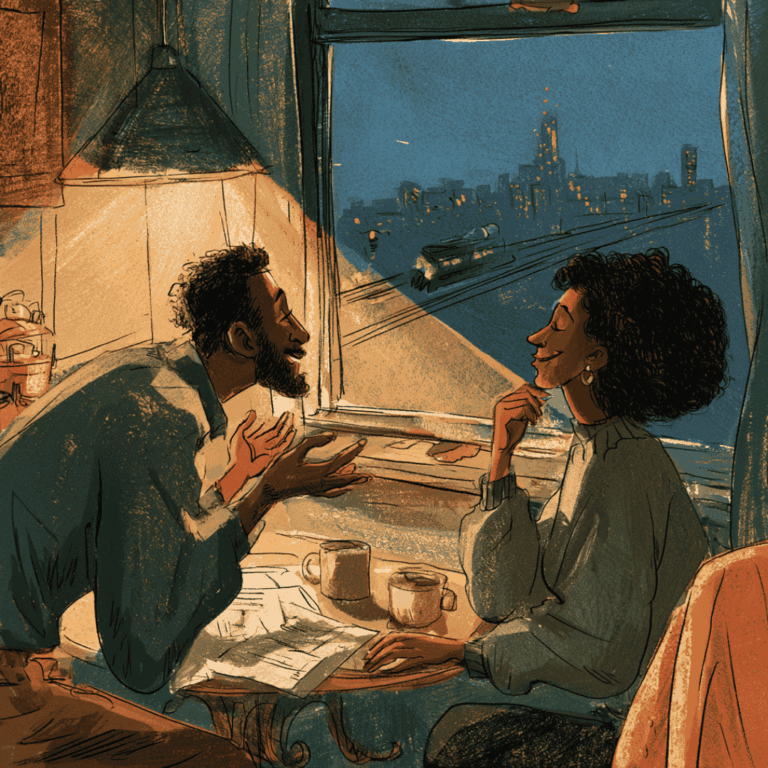
Marcus gets the offer of his career — but saying yes means asking Dana to leave her whole life behind. One kitchen-table conversation will decide their future.
This story is about a big decision — and it is full of the future. English has four main ways to talk about the future. Meet them before you listen:
Listen to the whole story once. Then tap the Questions button on the player and choose the best answer — you’ll see right away if it’s correct.
Marcus had a hard week, so he was not ready for good news. On Friday afternoon, his manager called him into her office and offered him a bigger job at the company’s new branch in the capital. Marcus asked for the weekend to think about it, but in his heart he already knew what he was going to say.
That evening, he told his wife, Dana. “They want me to lead a small team,” he said. “I’m going to acceptbe going to · a decision already made; a plan.. I start on the first of Septemberpresent simple · a timetable or fixed date..” Dana was quiet for a moment. “So we’re movingpresent continuous · an arrangement that feels fixed.,” she said. It was not a question.
They made plans at the kitchen table. “I’ll find us an apartmentwill · deciding or offering at the moment of speaking. near the office,” Marcus said. “You’re going to love the city. There are parks, cafés, and a big train station. The fast train leaves for our hometown every hourpresent simple · a timetable., so we’ll visit your parents often.” Dana smiled, but she still looked worried. “What about my job?” she asked.
“You’ll find something betterwill · a prediction. there,” Marcus said. “And if you don’t like it, we’ll come backwill · a promise.. I promise.” Whatever happened, he was going to make this work.
By midnight, they had a plan. Next week, Dana is going to talk to her bossbe going to · a plan for the near future. and give her notice. Then, in August, the two of them are going to pack all of their things into boxes. On September the first, Marcus will start his new job, and their new life together will begin. “In a year,” Marcus said, “we’re going to look back and laugh at how scared we were tonight.” Dana took his hand. “Maybe,” she said. “But first, we have a lot of boxes to fill. And you’re carrying the heavy ones.”
Listen again and read along with the transcript. Then tap the Questions button on the player and answer each one.
Marcus had a hard week, so he was not ready for good news. On Friday afternoon, his manager called him into her office and offered him a bigger job at the company’s new branch in the capital. Marcus asked for the weekend to think about it, but in his heart he already knew what he was going to say.
That evening, he told his wife, Dana. “They want me to lead a small team,” he said. “I’m going to acceptbe going to · a decision already made; a plan.. I start on the first of Septemberpresent simple · a timetable or fixed date..” Dana was quiet for a moment. “So we’re movingpresent continuous · an arrangement that feels fixed.,” she said. It was not a question.
They made plans at the kitchen table. “I’ll find us an apartmentwill · deciding or offering at the moment of speaking. near the office,” Marcus said. “You’re going to love the city. There are parks, cafés, and a big train station. The fast train leaves for our hometown every hourpresent simple · a timetable., so we’ll visit your parents often.” Dana smiled, but she still looked worried. “What about my job?” she asked.
“You’ll find something betterwill · a prediction. there,” Marcus said. “And if you don’t like it, we’ll come backwill · a promise.. I promise.” Whatever happened, he was going to make this work.
By midnight, they had a plan. Next week, Dana is going to talk to her bossbe going to · a plan for the near future. and give her notice. Then, in August, the two of them are going to pack all of their things into boxes. On September the first, Marcus will start his new job, and their new life together will begin. “In a year,” Marcus said, “we’re going to look back and laugh at how scared we were tonight.” Dana took his hand. “Maybe,” she said. “But first, we have a lot of boxes to fill. And you’re carrying the heavy ones.”
Four forms, four different jobs. Read each example out loud.
Type the verb in the best form — the label shows its function. Contractions are fine.
From memory — no labels. Type the verb in the best form.
You listened, noticed four ways to talk about the future, and used them yourself. Come back any time — hearing the forms in the story again is how they stick.
Can you remember one story sentence for each form? Say them out loud.