Objectives
By the end of this lesson, students will be able to:
-
Engage in absurd and unpredictable conversations using advanced speaking skills
-
Express disagreement, doubt, or curiosity in strange situations
-
Use sarcasm, and figurative language to respond creatively
-
Practice improvisational speaking in high-stress or humorous scenarios
Warmer
In pairs, brainstorm three ridiculous but possibly believable theories (e.g. “Birds are government drones”).
Pre-listening Questions
Have you ever been stuck in an elevator or weird situation? What happened?
How do you stay calm when things get weird or out of control?
Pre-listening vocabulary
Read the sentences and guess the meaning of the words in bold.
- The idea that elevators are secretly time machines sounds a little far-fetched, don’t you think?
- I started watching one conspiracy video, and next thing I knew, I’d gone down a rabbit hole for two hours.
- She believes a secret society is behind every major decision in politics and entertainment.
- They think the power outage was a government cover-up to distract from the real issue.
- He kept repeating the same strange ideas—I honestly think he’s been brainwashed.
- The elevator skipping the 13th floor isn’t a coincidence—it’s a glitch in the system.
- Some people think every phone call is under surveillance by a shadowy agency.
- Once you connect the dots, you’ll realize this entire building is a simulation.
Matching exercise
Vocabulary Gap-fill
Listening
Listening for Gist
Comprehension Questions
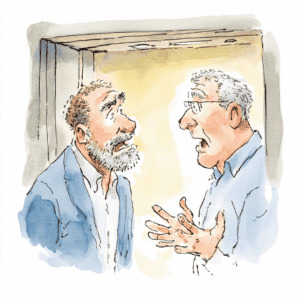
Listen again and answer the questions.
Why does one speaker think the elevator is not just broken?
What is the other speaker’s attitude toward these theories?
What is said about surveillance, and how is it reacted to?
Identify two sarcastic comments.
Which phrase suggests the speaker has explored too many conspiracy theories?
What does “Order of the Silver Key” likely symbolize?
Who seems more rational in the dialogue? Why?
Answers
Why does one speaker think the elevator is not just broken?
They believe it’s a mobile lab used by a secret organization to test people’s reactions—part of a larger conspiracy.What is the other speaker’s attitude toward these theories?
Skeptical, sarcastic, and dismissive; they clearly don’t take the theories seriously.t.What is said about surveillance, and how is it reacted to?
One person claims there’s a hidden camera watching them. The other person jokingly asks for help—and psychologist—showing they don’t believe it.Identify two sarcastic comments.
“I think you’ve just been watching too much Netflix.”
“If If you’re a member, I want no part in it.”
Which phrase suggests the speaker has explored too many conspiracy theories?
“You’ve gone down a serious rabbit hole, haven’t you?”Who seems more rational in the dialogue? Why?
The skeptical speaker appears more rational—they use sarcasm, logical reasoning, and humor to stay calm.
Text
A: Okay, it’s official. We’re stuck.
B: Or… are we exactly where they want us?
A: Oh no. Please don’t say this is some kind of secret society thing.
B: Not just any secret society. The Order of the Silver Key.
A: You do know stuff like that doesn’t really exist, right?
B: That’s what they want you to think! You’ve been brainwashed by mainstream media.
A: I think you’ve just been watching too much Netflix.
B: Look at the panel—there’s a glitch in the system. The numbers don’t even light up!
A: That’s called bad maintenance.
B: This is surveillance. There’s probably a camera hidden in the vent.
A: If someone is watching, please send help—and a psychologist.
B: You joke, but this is serious. This elevator is a mobile lab. A test.
A: And the point of the test is?
B: To see if we are worthy.
A: Oh, jeez, you’ve gone down a serious rabbit hole.
B: The truth is never far-fetched. Only hidden.
A: I’m pretty sure that sentence proves otherwise.
B: Just connect the dots! The blinking lights. The humming noise. The fact that we skipped the 13th floor.
A: Oh god, please get me out of here.
B: We must’ve been chosen to join the order.
A: If you’re a member, I want no part in it.
B: Wait… do you hear that clicking sound? It’s starting! This is it! Order here we come!
Post-listening activity
Discussion Questions
Answer the questions
- Why do some people believe in conspiracy theories?
- Is it possible to disagree with someone respectfully? How?
- What makes someone seem “crazy” versus just “creative”?
Role Play 1
Student A is stuck in an elevator. Student B is a conspiracy theorist who believes the elevator is part of a secret experiment. Use at least 3 vocabulary words from the lesson. Keep the conversation going for 3 minutes.
A’s Goal: Stay calm and try to make sense of the situation.
B’s Goal: Convince A that this is all part of a massive plan.
Role Play 2
You’re both stuck in a never-ending elevator.
But here’s the twist—each of you has a secret.
Student A: You’re secretly a spy and think B might be dangerous. You want to escape without revealing your identity.
Student B: You believe this elevator is actually a spaceship, and Student A might be an alien in disguise.
Challenge:
Keep the conversation going for 4–5 minutes without breaking character. Use sarcasm, humor, suspicion, and at least 2 idioms or metaphors.