Skip to content
Objectives
By the end of this lesson, students will be able to:
- Students will be able to understand and accurately C1 vocabulary words related to social withdrawal
- Students will demonstrate listening comprehension of the hikikomori video by identifying the main ideas
- Students will express and support opinions about cultural and social issues by participating in open-ended discussions and performing a structured role-play on social withdrawal.
Warmer
Silent Room Challenge
Ask students to sit in silence for 60 seconds while imagining themselves completely isolated in a single room for 6 months.
- How did the silence feel and what would you struggle with most?
Answer the following questions.
- Why do you think some people choose to withdraw from society?
- Can extreme isolation be healthy, or is it always harmful?
Pre-listening
Pre-listening vocabulary
Read the sentences. Brainstorm words that can be use instead of the words in bold. You may have to change word order.
He became so reclusive after losing his job that no one saw him for months.
In societies shaped by collectivism, people often feel obligated to follow the expectations of their community.
The sudden rise in online-only friendships is a modern phenomenon.
Her cheerful personality was just a facade masking her stress.
The traumatic incident left him unable to return to school for months.
His overprotective parents refused to let him make his own decisions.
Counselors created a slow reintegration plan to help her adjust back to social routines.
The prevalence of long-term isolation among young adults has increased dramatically.
He chose to share his story anonymously to avoid public judgment.
Matching exercise
Vocabulary Gap-fill
Complete the text
Video
Listening for Gist
Comprehension Questions
Listen again and answer the questions.
Expressions & Phrases
What do the expression in bold mean?
Text
HIKIKOMORI
It’s the modern-day phenomenon of acute social withdrawal, especially amongst young people in urban Japan.
An estimated over half a million young people have become social recluses, as well as half a million middle-aged people, primarily men.
They isolate for long periods of time—over six months to years to even decades.
It has even been compared to PTSD and goes much further than agoraphobia, which is simply a fear of public spaces.
Academic
Japan’s school system is very strict.
One’s education is highly important to one’s future career, and failing at school is viewed as shameful both individually and for the whole family.
Hikikomori usually start the path to becoming a social recluse after experiencing one or more traumatic episodes of academic failure.
Before graduating, students will attend a highly choreographed ritual called shoshoku katsudo, or job hunting activity, to form relationships with companies that are looking to hire graduates.
Job positions in Japan are extremely competitive and therefore highly sought after.
Professors have regular contact with companies who ask for recommendations of students each year, meaning those who don’t keep up with schoolwork are often overlooked.
It is thought that the doors only open once.
If applicants are successful, they achieve a comfortable corporate position for life; if not, then they often settle for low-paying jobs with little job security.
This has led to the so-called lost generation—middle-aged men who never found a real career after finishing school.
These men and women live at home with their parents, shunning social interaction entirely.
Social
Hikikomori is such a problem in Japan that there are multiple forms of rehabilitation and therapy to help reintegrate people back into society.
This goes as far as issuing DVDs of live-action women staring into the camera to help hikikomori learn to cope with eye contact and long spans of human interaction.
Visiting a psychiatrist, however, can be seen as shameful in itself—and a reason to be socially shunned—so most hikikomori simply continue their persistent avoidance of social situations and relationships.
Young adults in particular can often be overwhelmed by society, one that often tends toward conformity and collectivism, or feel unable to fulfill their expected social roles.
Hikikomori may cite their choice of social withdrawal on a lack of independent thinking and sense of self that Japanese society is unable to accommodate.
In Japan there is the concept of honne–tatemae.
Tatemae is the public facade—fulfilling what is expected of them in society in order to fit in.
Honne is one’s true self and true thoughts and feelings.
This can often cause internal conflict; as the Japanese saying goes: “The nail that sticks out gets hammered in.”
Technological
Modern technology is another major factor in the prevalence of hikikomori.
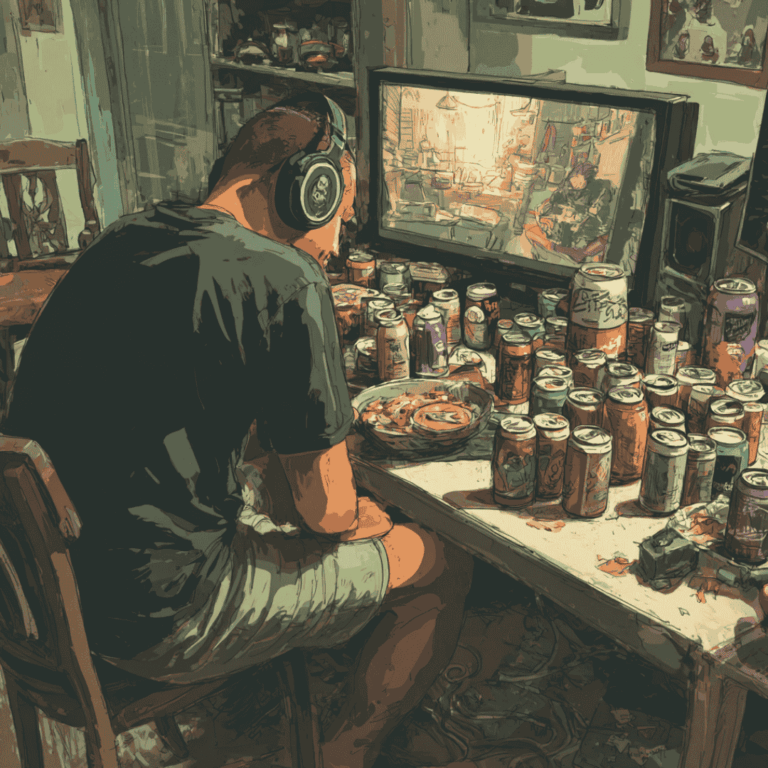
Allowing the veil of social interaction to be entirely through social media or video games—sometimes even anonymously—allows individuals to feel they are engaging socially when in fact they are isolated.
Internet and video game addiction have reduced the amount of time that people spend outside in social environments that require direct face-to-face interaction.
The internet, for hikikomori, is somewhat of a double-edged sword:
It can facilitate a lack of interest in establishing physical relationships with other people and is often used as an escape from depression in everyday life.
But it may also be beneficial in terms of improving the quality of social life, as it provides the opportunity to meet people virtually with common interests and similar problems.
The urge to avoid social interaction is so strong with some individuals that they fail to seek medical attention if needed, and doctors will even resort to meeting patients virtually.
Parental
Hikikomori are most often from middle-class backgrounds, as their parents can afford to keep an adult at home indefinitely.
Lower-income families rarely have hikikomori children because they are forced to work outside the home.
This culture of overprotective parenting is known as “amae” or soft parenting, where parents do not act upon their child’s slip into isolation and provide the financial means to facilitate it.
Receiving social welfare can also be seen as shameful in Japanese society, so hikikomori are often entirely reliant on their parents.
The longer a child is allowed to live as a hikikomori, the more difficult it is to reintegrate them into society.
This leads to the so-called 80–50 problem, where children live as hikikomori into their 50s, depending on parents who are in their 80s.
Global Context
Hikikomori is not solely a Japanese problem.
It affects one percent of the Japanese population, but many young people around the world feel isolated and excluded from society—partly because of social or academic pressures, partly because of the addictive nature of the internet.
Previously, however, the issue of hikikomori had been swept under the carpet—an embarrassing aspect of Japanese society beyond help and understanding.
Hopefully, with the issue of hikikomori becoming more known in the wider world, those who are currently isolated are in a better position to be understood and to be given help.
Post-listening activity
Discussion Questions
Answer the questions
- How do cultural expectations shape our willingness to socialize?
- Could hikikomori become more common in Western countries? Why or why not?
- Can technology both help and harm our mental health? How?
- What responsibilities do parents have when an adult child refuses to leave the house?
- Is social withdrawal always a personal choice, or can society create it?
Role Play - Guest Speaker
Situation:
One student is a social worker meeting with a young person who has lived in isolation for 8 months.
Role A: (Social Worker) Ask gentle questions to understand what triggered the isolation, what dialy life looks like, and what small steps might help.
Role B: (Hikikomori) Explain your fears, pressure, and what makes it difficult to reintergrate. In the end, decide if you are ready to take steps towards change.
Take 5 minutes to prepare for your roles.