Skip to content
Objectives
By the end of this lesson, students will be able to:
- Understand and use vocabulary related to home repairs and renovations
- Discuss damage and renovation timelines with natural fluency
- Role-play a casual on-site inspection conversation
Warmer
What would you do?
Have you ever visited a home that needed a lot of repairs?
What are signs that a property is too far gone to fix?
What would you renovate first in an old house?
Pre-listening
Have you ever been stuck in an elevator or weird situation? What happened?
How do you stay calm when things get weird or out of control?
Pre-listening vocabulary
Read the sentences and guess the meaning of the words in bold.
That run-down house has good bones, but it needs everything done.
Once it’s all done up, it could be worth double.
The old garage was so unstable, it was reduced to rubble in minutes.
All the windows were boarded-up — pretty eerie, honestly.
The bathroom ceiling fell in after the last storm.
The kitchen is laid out well, but the wiring’s ancient.
The front door’s completely smashed up — probably from a break-in.
The bathroom’s full of cracked tiles and water stains.
The attic has rotting beams that’ll need replacing.
You can see water damage near the baseboards.
Matching exercise
Vocabulary Gap-fill
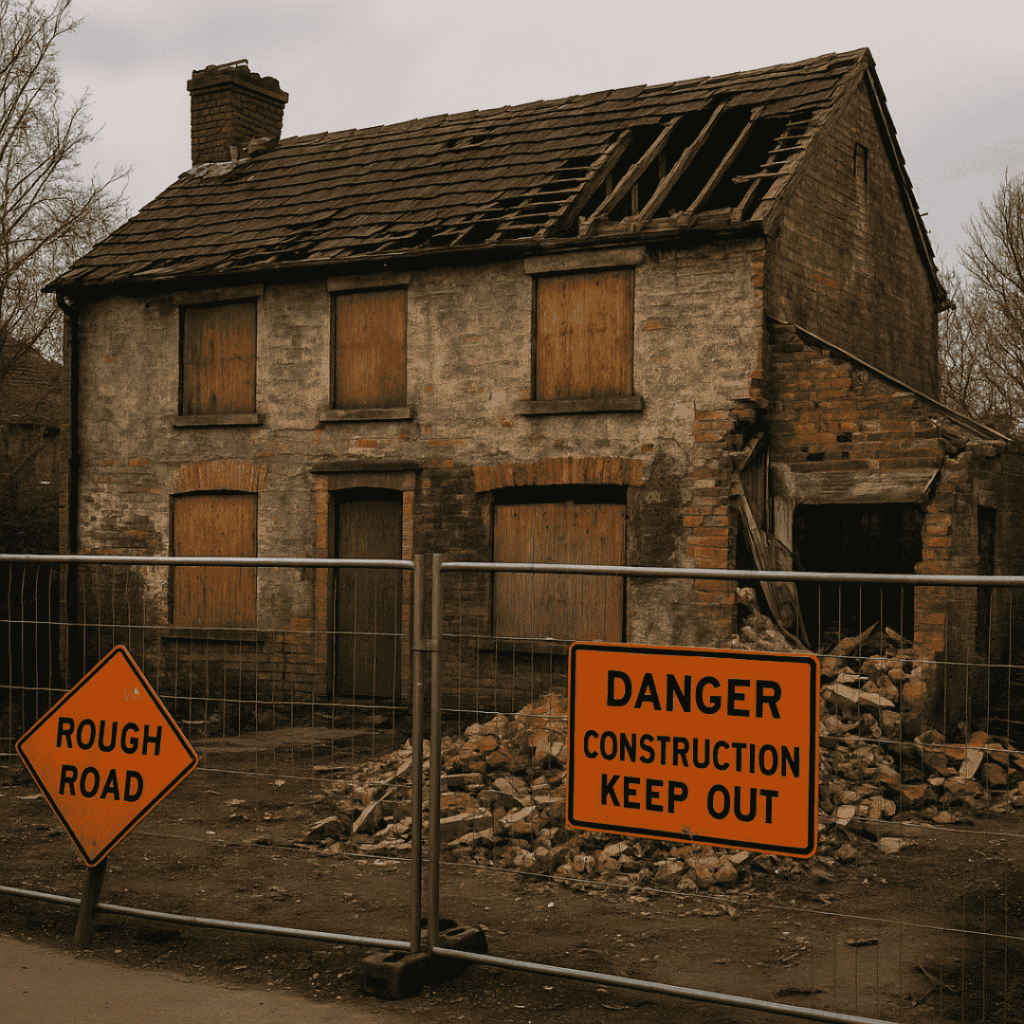
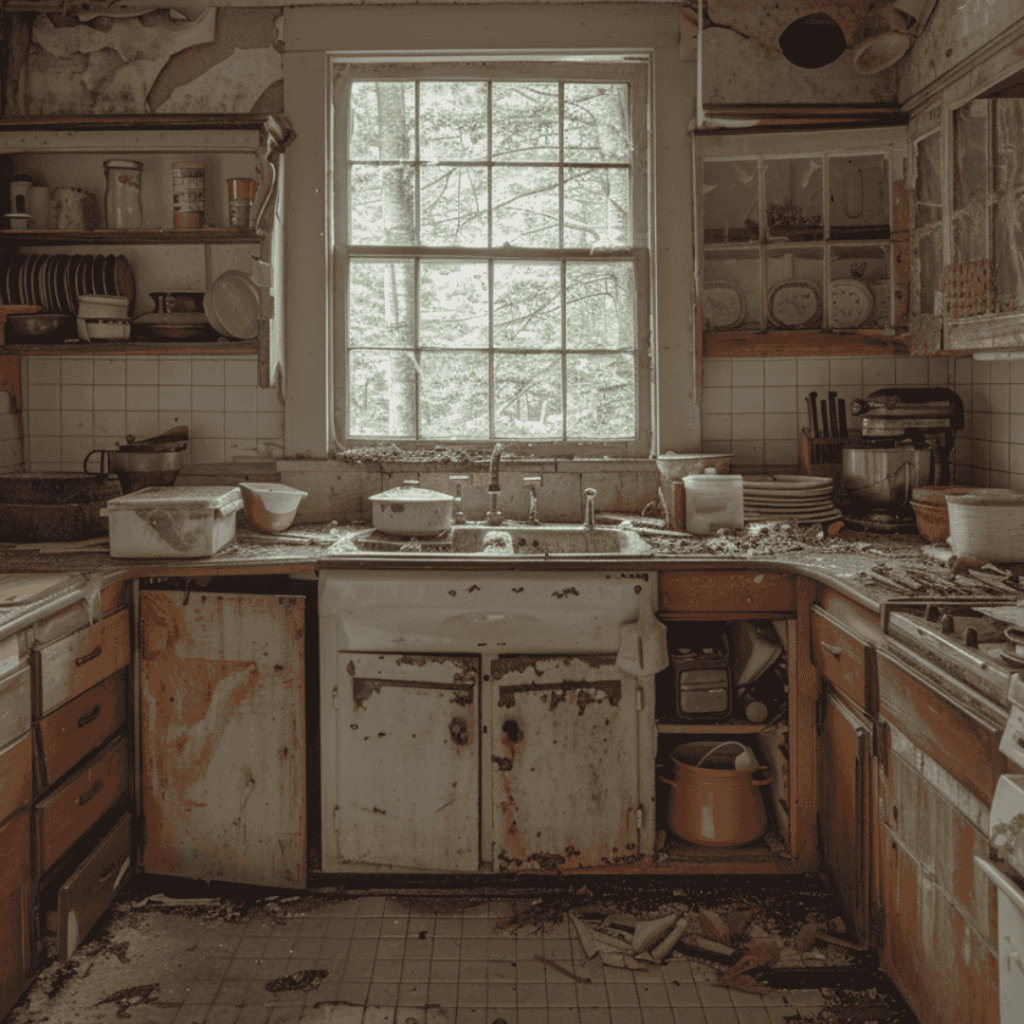
Describe the pictures
Use the new vocabulary to describe the images below.
Listening
Listening for Gist
Comprehension Questions

Listen again and answer the questions.
- What are some of the major problems with the house?
- What’s the condition of the foundation?
- Which room is boarded up and why?
- When can the contractor begin work?
Answers
What are some of the major problems with the house?
Boarded-up windows, collapsed ceilings, smashed-up walls, rotting beams, and water damage.What’s the condition of the foundation?
Surprisingly solid — it’s one of the few things that can be salvaged.Which room is boarded up and why?
A room in the back — the ceiling is unstable and might collapse.When can the contractor begin work?
As early as Monday, if permits go through.
Key Phrases
Text
A: Wow… this place looks even more run-down in person.
B: Yeah, it’s definitely seen better days. The roof nearly fell in last winter.
A: Seriously? I thought it just needed a bit of TLC.
B: You’ll need more than that. The whole place needs a good paint job. Half the back wall’s smashed up, and there’s water damage in the kitchen.
A: Is anything actually salvageable?
B: The foundation’s solid, which is a miracle. The place is laid out pretty well, too.
A: That’s something. Where do we begin?
B: Well, first we’d have to start by tearing out the bathroom — mold, cracked tiles, rotted pipes. Everything’s gotta go.
A: And what’s that boarded-up room at the back?
B: Oh, that’s where they buried the bodies.
A: Excuse me? Dead bodies?
B: I didn’t say there were dead now, did I?
A: Nah, I’ve seen enough.
B: Hahaha! I’m just pulling your leg
A: Man, you really had me there. I was about to call the cops. So what’s up with that room?
B: The ceiling’s a bit unstable might be best to knock it down. Could be reduced to rubble in a day.
A: I was hoping for a bit of a project, not a full rebuild.
B: You’ve got a project all right. But hey, once it’s cleaned up, it’ll look great.
A: How long before we can get started?
B: Monday, if we get the permits. I’ve got a team ready to go.
A: Alright, let’s say we go ahead. When do you think the first phase would be done?
B: Six to eight weeks, depending on the weather and unexpected surprises.
A: There are always surprises, huh?
B: Always. But nothing we can’t handle.
Post-listening activity
Discussion Questions
Answer the questions
Have you ever entered a building that felt unsafe? What made it feel that way?
Would you consider buying a fixer-upper? Why or why not?
Which parts of a home should be prioritized during renovation?
Do you think restoring old homes is worth the cost and time?
How can contractors make the renovation process less stressful?
Role Play 1
A potential buyer (Student A), is meeting a contractor, (Student B), to assess a run-down property. The contractor must walk through each room, describe what’s wrong, suggest fixes, and estimate the timeline. The buyer must ask specific questions, show concern, and consider whether to move forward.
Role A:(Buyer)
Ask specific questions about rooms (e.g. “What’s the situation in the attic?”)
Express concern about the condition and cost
Negotiate possible fixes (e.g. “Can we save the floors?”)
Ask about timeline, team size, and what’s included in the estimate
Use polite but firm language (e.g. “I’d need that done before winter.”)
Role B: Captain 1
Use clear, realistic descriptions of the damage
Suggest cost-saving ideas (e.g. using reclaimed materials)
Explain necessary steps (e.g. “We’d start by removing the walls…”)
Offer a rough timeline and possible challenges
Be honest but reassuring
Role Play 2
The renovation has already started. Midway through, a major problem is discovered that could increase costs and delay the timeline. The contractor must break the news and present options. The buyer must decide how to proceed: continue, adjust the plan, or possibly pause the project.
Role A: Buyer
Ask for clarification and visual proof if needed
Express concern or frustration without being rude
Make a decision based on budget and timeline
Ask if anything else could still go wrong
Role B: Contractor
Clearly explain the newly discovered issue
Propose at least two solutions (e.g. repair vs. full replacement)
Be transparent about additional costs and delays
Offer a realistic, updated timeline